|
J
|
F
|
M
|
A
|
M
|
J
|
J
|
A
|
S
|
O
|
N
|
D
|
|
J
|
F
|
M
|
A
|
M
|
J
|
J
|
A
|
S
|
O
|
N
|
D
|
|
J
|
F
|
M
|
A
|
M
|
J
|
J
|
A
|
S
|
O
|
N
|
D
|
About this plant
What makes this plant special
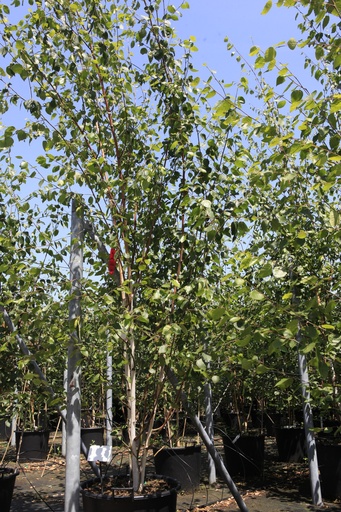
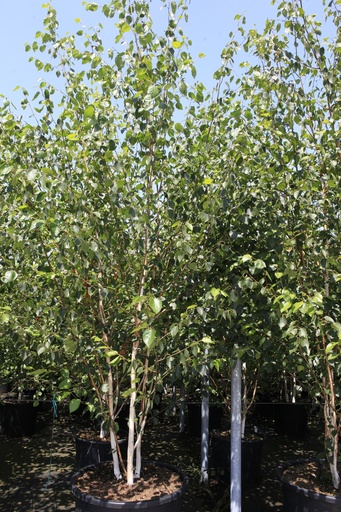
The bark of this birch only turns fully white after four to six years, on the trunk and sometimes on the branches too, and then contrasts with the dark, glossy green leaves. It is equally handsome as a single-stemmed or multi-stemmed tree and can be pollarded to keep it in scale in a smaller garden.
Silver Birch Betula
Birches (Betula) are deciduous trees and shrubs from the cool and temperate parts of the Northern Hemisphere, from the Arctic to the mountains of Asia and North America. They are pioneer trees with a light, airy crown and fine twigs that carry catkins from autumn until spring. Gardeners value them above all for their peeling bark in white, cream, pink, copper or brown, and for their yellow autumn colour.
Himalayan birch Betula utilis jacquemontii
This variety (Betula utilis var. jacquemontii) is the white-barked form of the Himalayan birch from the western Himalaya. Its bright, pure white bark peels in sheets to show darker new bark and stands out in every season, especially in winter. It grows more slowly than most birches into an upright tree with a light, open crown and leaves that turn yellow in autumn.
Location and soil
Sun or partial shade, in a fresh, fertile, humus-rich soil that drains well but does not dry out in summer; preferably slightly acid, though neutral to slightly chalky soil is fine. It thrives in cool climates, in the north and in uplands. The shallow roots make it sensitive to prolonged drought and strong wind. It is very hardy.
Pruning and care
Water in dry summers during the first years and plant it straight in its final place, as it does not like to be moved. It can be left to grow freely; to keep it smaller it can be pollarded, preferably in March. Washing the trunk with mildly soapy water in autumn brings out the white of the bark.
Use in the garden
A reference tree for white gardens and contemporary designs, as a solitary, in a group or as a multi-stemmed clump. It contrasts well with dark foliage, coloured dogwood stems and winter-flowering shrubs, and young trees can be grown for some years in a large container.
Plant characteristics
Botanical
| Family | Betulaceae |
| Genus | Betula |
| Species | utilis jacquemontii |
Flowering
| Flowering period | february to april |
| Colour (flower) | yellow, green |
Foliage
| Evergreen | no |
| Colour (foliage) | green |
Growth habit
| Height | 500 cm, 1000 cm |
| Trunk/branches | conspicuous |
Location
| Winter hardiness | -35 °C |
| Soil type | acid, all |
| Soil type | acid, all |
| Location | sun, half shade |
| Soil moisture | moist |
Use
| Type (use) | tree/standard, solitary |
Care
| Pruning | march |