



About this plant
Crataegus
Hawthorns (Crataegus) are thorny, deciduous shrubs and small trees found across the Northern Hemisphere, with more than a hundred species and many hybrids. In May they cover themselves in clusters of scented white, pink or red flowers that are very popular with bees, followed by red, yellow or dark haws that feed birds well into autumn.
Crataegus lavalleei
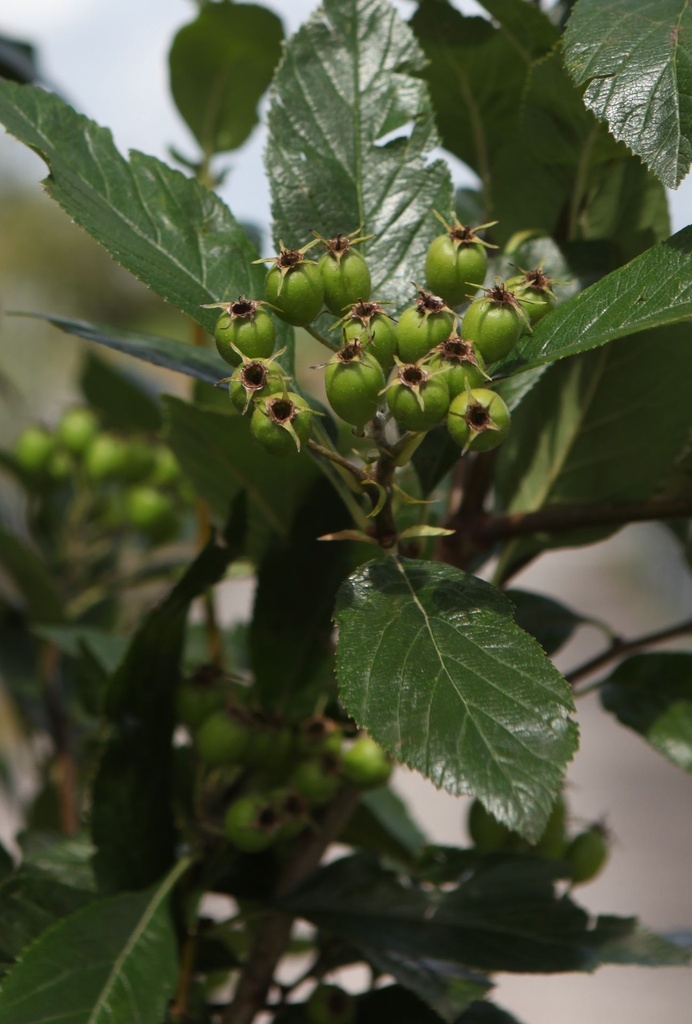
Lavallée's hawthorn (Crataegus × lavalleei) is a hybrid that arose in France in the 19th century and forms a small, dense, rounded tree of around 5 to 7 m. Its leathery, glossy dark green leaves hang on far into winter, and the white May flowers give way to masses of orange-red fruits that stay on the branches until midwinter.
Location and soil
Plant in sun or partial shade in any well-drained soil, from dry to moist, including chalky and clay soils. It tolerates wind and coastal conditions and is very hardy in Belgium.
Pruning and care
An easy tree that needs little attention. If necessary, give it a light balancing prune in February or March to keep the crown well shaped. Like other hawthorns it can be affected by fire blight, so remove any blackened shoots promptly.
Use in the garden
A fine small tree for gardens, patios, streets and planters, grown on a single stem or as a multi-stemmed tree. Its persistent fruits brighten the winter and are eagerly eaten by birds, while the flowers attract bees.
Plant characteristics
Care
| Pruning | february, march |
Related products

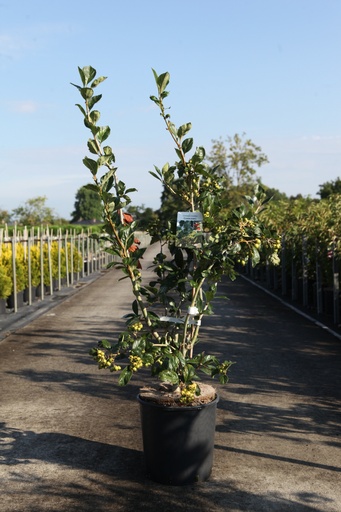
Crataegus lavalleei 'Carrierei'
cont. 7,5L 80/+ cm +p
Crataegus lavalleei 'Carrierei'
cont. 18L 125/+ cm +p

Crataegus lavalleei 'Carrierei'
cont. 70L 150-175 cm multi-stem