|
J
|
F
|
M
|
A
|
M
|
J
|
J
|
A
|
S
|
O
|
N
|
D
|
|
J
|
F
|
M
|
A
|
M
|
J
|
J
|
A
|
S
|
O
|
N
|
D
|
|
J
|
F
|
M
|
A
|
M
|
J
|
J
|
A
|
S
|
O
|
N
|
D
|
About this plant
Autumn olive, Silverberry Elaeagnus
Oleasters (Elaeagnus) are deciduous or evergreen shrubs and small trees from Asia, southern Europe and North America, sometimes thorny. Leaves and buds are covered with tiny silvery scales. Their small, often strongly scented flowers attract pollinators and are followed by edible berries. They tolerate poor soil, wind and salt and fix nitrogen.
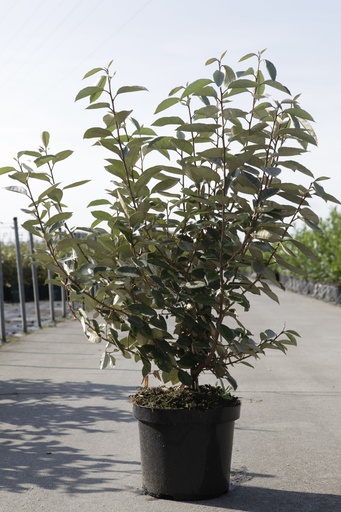
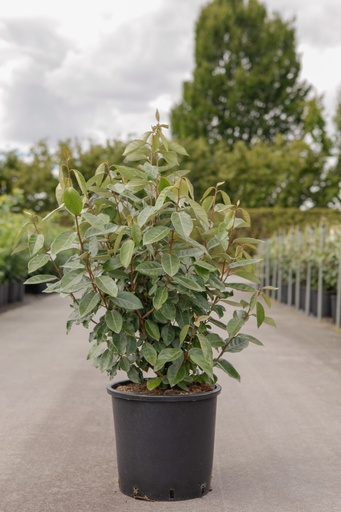
Silverberry Elaeagnus ebbingei
Elaeagnus ebbingei is a garden hybrid of E. macrophylla and E. pungens, raised in the Netherlands in the last century. It is a dense, fast-growing evergreen shrub of up to about 3 to 4 m, with leaves that are glossy dark green above and silvery beneath. Small, sweetly scented cream flowers appear in autumn, followed by edible fruits.
Location and soil
Sun or partial shade, in a deep, well-drained soil. It grows even in poor, dry or slightly salty ground and copes with coastal wind and polluted air. It prefers neutral to acid soil; on very chalky ground the leaves may turn yellowish. Hardy in most Belgian winters; in severe cold it may lose part of its leaves.
Pruning and care
Cut back by about a third in the first years to build a compact, bushy plant. As a clipped hedge, trim twice a year, in February or March and again in July. As a free-growing shrub, a light tidy-up in February or March is enough. Avoid waterlogged soil, which encourages fungal disease.
Use in the garden
One of the most popular evergreen hedge plants, suitable for formal and informal hedges, screens and windbreaks, including on the coast and in industrial areas. It also works as a solitary shrub or in mixed borders, where its autumn flowers bring scent and bees.
Plant characteristics
Botanical
| Family | Elaeagnaceae |
| Genus | Elaeagnus |
| Species | ebbingei |
Flowering
| Flowering period | october to november |
| Colour (flower) | white |
| Flowers | fragrant, inconspicuous |
Foliage
| Evergreen | yes |
| Colour (foliage) | green, silver |
Growth habit
| Height | 200 cm, 300 cm |
Location
| Winter hardiness | -20 °C, -15 °C |
| Location | sun |
| Wind resistant | yes |
| Soil moisture | normal |
Use
| Type (use) | shrub, hedge plant, fruit/berries, in group |
| Fruits/berries | pink |
Care
| Pruning | february to march, july |