

|
J
|
F
|
M
|
A
|
M
|
J
|
J
|
A
|
S
|
O
|
N
|
D
|
|
J
|
F
|
M
|
A
|
M
|
J
|
J
|
A
|
S
|
O
|
N
|
D
|
|
J
|
F
|
M
|
A
|
M
|
J
|
J
|
A
|
S
|
O
|
N
|
D
|
About this plant
What makes this plant special
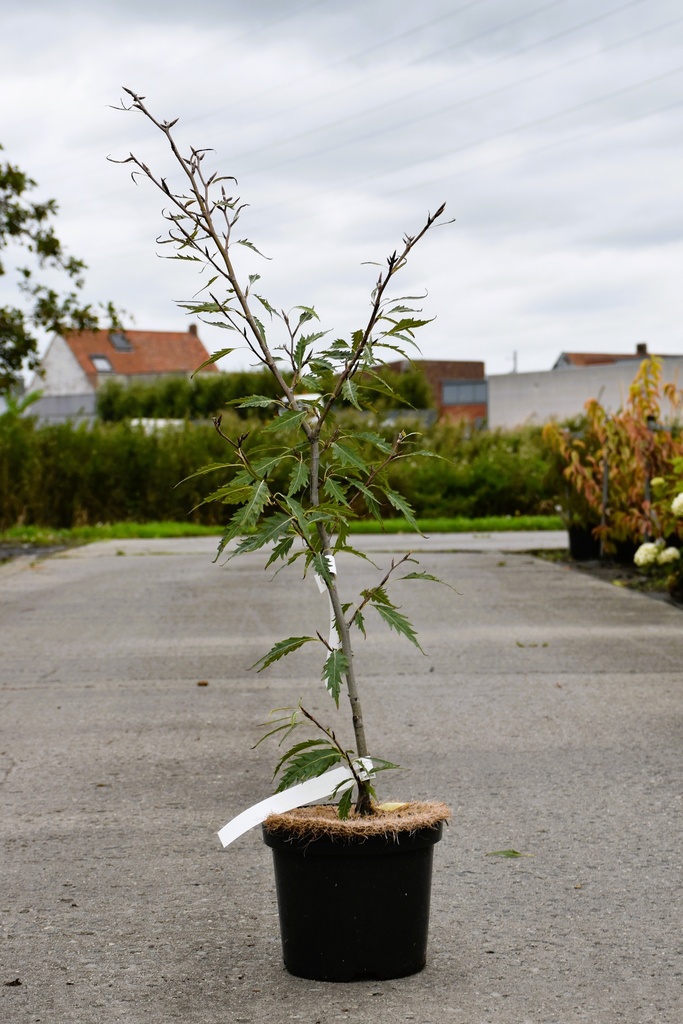
'Aspleniifolia' is grown for its leaves, which are irregularly slashed into narrow lobes, some almost ribbon-like, giving the dense crown a soft, feathery texture. It reaches 10 to 15 m with an equally broad, rounded head, turns warm golden yellow in autumn and has been cultivated since about 1804, originating in France.
Beech Fagus
Beeches (Fagus) are large deciduous trees of the temperate northern hemisphere and belong to the beech family. They have smooth grey bark, glossy oval leaves with wavy margins and small three-sided nuts in spiny husks. Alongside the forest tree there are many garden forms with purple, golden or variegated foliage and columnar or weeping habits.
Purple beech Fagus sylvatica
European beech (Fagus sylvatica) is native to large parts of Europe and is one of the main forest trees of our region. Given space, it grows into an imposing tree of up to around 30 to 35 m. The leaves unfold fresh green in May and turn yellow-brown to copper in autumn; on young trees and hedges the dry leaves remain until spring.
Location and soil
Prefers a humus-rich, well-drained soil that is not too wet, in sun or partial shade. Exposed sites, compacted ground and paving over the roots are poorly tolerated, and the thin bark of older trees can scorch in strong sun. Fully hardy in Belgium, but it suffers in hot, dry summers.
Pruning and care
Water young plants in dry spells during their first years. Hedges and topiary are best clipped in February and March, before bud break. Free-standing trees need little pruning beyond removing dead or crossing branches at that time.
Use in the garden
A classic choice for windbreak and screening hedges that keep their brown leaves through winter. In parks and large gardens it makes a majestic specimen tree. Cultivated forms with purple, golden or deeply cut leaves and narrow, columnar habits bring the species into smaller gardens as well.
Plant characteristics
Botanical
| Family | Fagaceae |
| Genus | Fagus |
| Species | sylvatica |
| Cultivar | 'Aspleniifolia' |
Flowering
| Flowering period | april to may |
| Colour (flower) | yellow, green |
Foliage
| Evergreen | no |
| Colour (foliage) | green |
Growth habit
| Height | >1000 cm |
Location
| Winter hardiness | -25 °C |
| Location | sun, half shade |
Care
| Pruning | february to march |