|
G
|
F
|
M
|
A
|
M
|
G
|
L
|
A
|
S
|
O
|
N
|
D
|
|
G
|
F
|
M
|
A
|
M
|
G
|
L
|
A
|
S
|
O
|
N
|
D
|
|
G
|
F
|
M
|
A
|
M
|
G
|
L
|
A
|
S
|
O
|
N
|
D
|
Informazioni su questa pianta
Cosa rende speciale questa pianta
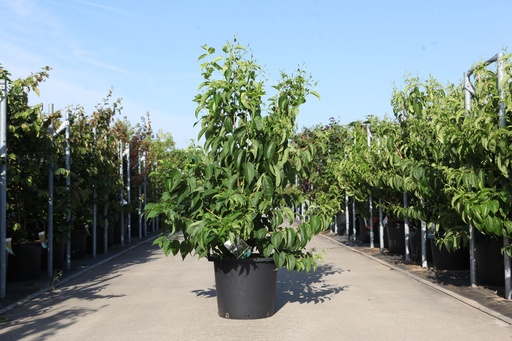
Long forgotten and rediscovered in a Belgian garden in the 1980s, Heptacodium miconioides draws bees and butterflies late in the season with its jasmine-scented flowers. Its glossy, slightly wavy leaves turn yellow to purple and only fall in late November, and the very hardy, multi-stemmed shrub can be trained on a single trunk to show off its bark.
Heptacodium
Seven-son flower (Heptacodium) is a small genus of deciduous shrubs and small trees from the mountains of eastern and central China. It is valued for its late flowering at the end of summer, when few other shrubs are in bloom, followed by a second show of colourful calyces in autumn and attractive peeling bark in winter.
Heptacodium miconioides
Heptacodium miconioides is the only species in the genus, a vigorous large shrub growing to around 4 m. From August to October it carries clusters of small, fragrant white flowers. Once they fade, the persistent calyces turn pink to cherry red and stay on until the frosts, while the pale bark peels in long strips on older wood.
Esposizione e terreno
Plant in full sun or partial shade, in any ordinary, deep garden soil that stays reasonably moist; clay and chalky soils are fine. The species is very hardy and withstands severe frost without protection. It tolerates short dry periods once established, but flowers best where the soil does not dry out in summer.
Potatura e cura
No pruning is needed for a natural shape. If required, cut back in March, shortening shoots by up to half to keep the shrub denser. To grow it as a small tree, select one or a few strong stems and regularly remove suckers and side shoots at the base. The plant is rarely troubled by disease.
Utilizzo in giardino
Best grown as a solitary shrub or multi-stemmed tree where its late flowers, red calyces and peeling bark can be seen up close, for instance near a terrace. It also fits into a free-growing flowering hedge or a mixed border and is a late-season magnet for pollinators.
Caratteristiche della pianta
Dati botanici
| Famiglia | Caprifoliaceae |
| Genere | Heptacodium |
| Specie | miconioides |
Fioritura
| Periodo di fioritura | august – october |
| Colore (fiore) | white |
Fogliame
| Sempreverde | no |
| Colore (fogliame) | green |
Portamento
| Altezza | 600 cm, 400 cm |
Posizione
| Rusticità | zona 5a (fino a -28,9 °C) |
| Caldo estivo | fino alla zona di calore 9 |
| Tipo di terreno | neutral |
| Esposizione | sun, half shade |
| Umidità del terreno | moist |
Utilizzo
| Tipo (uso) | shrub, solitary, in group |
| Frutti/bacche | showy, october, november, red |
Cura
| Potatura | march |