
Om denne planten
Abeliophyllum
The white forsythia (Abeliophyllum) is a deciduous shrub from the mountains of Korea, closely related to forsythia within the olive family. It is loved for its very early flowering: at the end of winter, before the leaves appear, the bare stems are covered with small, almond-scented white flowers, a soft alternative to bright yellow forsythia.
Abeliophyllum distichum
Abeliophyllum distichum is the only species in its genus and has become very rare in the wild. It forms a loose, rounded shrub of about 1.5 to 2 m with slender, arching branches. White flowers, sometimes tinged pink and with an orange-yellow centre, open from purplish buds in February and March; the leaves grow in two neat rows and turn golden to reddish in autumn.
Plassering og jord
Flowers most freely in full sun but tolerates light shade. Plant it in fertile, moist but well-drained soil that is neutral to slightly acidic, and avoid compacted or wet spots, where the roots may rot. It is very hardy and copes with severe frost; only in exposed sites can late cold damage the flowers.
Beskjæring og stell
Prune every year straight after flowering, in March or April, as the flower buds develop on the new shoots; renewing some of the oldest stems every few years keeps the shrub compact and free-flowering. Water regularly after planting until it is well established. Otherwise it is trouble-free and needs little attention.
Bruk i hagen
Best planted in groups or in a mixed border where the late-winter flowering can be appreciated, rather than as a summer focal point, since the shrub is fairly plain after flowering. It combines well with yellow forsythia and early bulbs, suits a low informal hedge or a large pot, and provides cut stems for forcing indoors.
Planteegenskaper
Blomstring
| Blomstringstid | february, March |
| Farge (blomst) | white |
| Blomster | fragrant |
Løv
| Eviggrønn | no |
| Farge (løv) | green |
Vekstform
| Høyde | 100 cm, 150 cm |
Voksested
| Vinterherdighet | -25 °C |
| Jordtype | acid, neutral |
| Voksested | sun, half shade |
| Jordfuktighet | moist, normal |
Bruk
| Type (bruk) | climbing, shrub |
Stell
| Beskjæring | no |
Relaterte produkter

Abeliophyllum distichum
kont. 0,5L småplanter (P10,5)
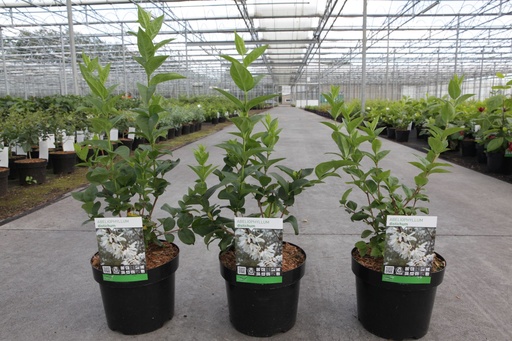
Abeliophyllum distichum
kont. 3L 30-40 cm +f
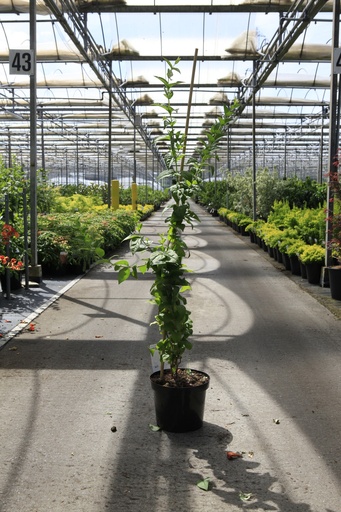
Abeliophyllum distichum
kont. 7,5L 50-60 cm +f