|
J
|
F
|
M
|
A
|
M
|
J
|
J
|
A
|
S
|
O
|
N
|
D
|
|
J
|
F
|
M
|
A
|
M
|
J
|
J
|
A
|
S
|
O
|
N
|
D
|
|
J
|
F
|
M
|
A
|
M
|
J
|
J
|
A
|
S
|
O
|
N
|
D
|
About this plant
What makes this plant special
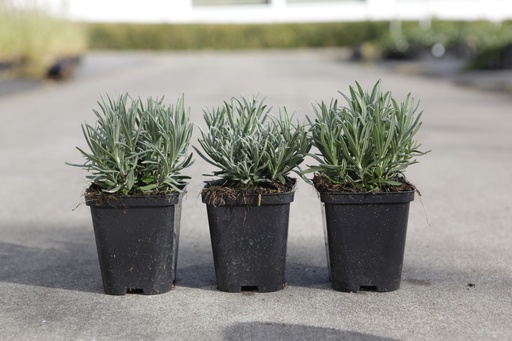
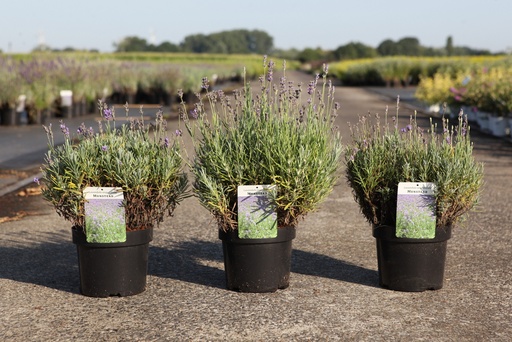
A widely grown compact lavender, also sold as 'Munstead Dwarf'. Its small blue-purple flowers are strongly scented, and the narrow grey-green leaves are aromatic too. Because it keeps a tight shape it lends itself to a low lavender hedge along a path or border, and to herb, scent and gravel gardens.
Lavender Lavandula
Lavandula, lavender, is a genus of some twenty-five aromatic subshrubs found from the Atlantic islands through the Mediterranean to India. The small flowers stand in stalked spikes above narrow, evergreen, mostly grey foliage. The hardiest are the true lavender, Lavandula angustifolia, and its hybrids (lavandin); the tufted French lavender, Lavandula stoechas, and other southern species are more tender.
English lavender Lavandula angustifolia
Lavandula angustifolia, the true or English lavender, grows wild in the western Mediterranean region, far inland and high into the mountains. It is a low subshrub with a woody base, narrow leaves that start grey and turn greener, and slender four-angled stems ending in spikes of lavender-purple flowers in summer. It is the source of true lavender oil; selections also flower in white and pink.
Location and soil
Full sun and free-draining soil are essential. It prefers poor to moderately fertile, dry ground, chalky soils included, and does not last in shade or in heavy clay that stays wet in winter; on such soil it is planted on a raised ridge or mound. Once established it withstands drought and sea wind.
Pruning and care
Without pruning lavender turns woody and bare, so it is trimmed every year. After flowering, in late summer, the spent flower stalks are cut away together with a little of the leafy growth; in March or April the plant can be clipped more closely into shape. Cuts are never made into old, leafless wood, which does not sprout again.
Use in the garden
The classic plant for a low hedge or edging along a path or border, and equally at home in herb and scented gardens, rock and gravel gardens, sunny borders and pots. Both flowers and leaves are dried for their scent.
Plant characteristics
Botanical
| Family | Lamiaceae |
| Genus | Lavandula |
| Species | angustifolia |
| Cultivar | 'Munstead' |
Flowering
| Flowering period | june to august |
| Colour (flower) | blue |
Foliage
| Evergreen | yes |
| Colour (foliage) | green |
Growth habit
| Height | 50 cm |
Location
| Winter hardiness | zone 5a (down to -28,9 °C) |
| Summer heat | up to heat zone 8 |
| Soil type | kalkrijk |
| Location | sun, half shade |
| Soil moisture | dry, normal |
Use
| Type (use) | shrub, hedge plant, solitary, ground cover, in group, terrace plant |
Care
| Pruning | august to september |